martes, 29 de septiembre de 2009

PERUVIAN JOURNAL OF APPLIED PHILOSOPHY # 12: JOSE CARLOS MARIATEGUI, A PERUVIAN SOCIALIST THINKER


ABSTRACTS

PHILOSOPHY, TO PHILOSOPHIZE AND PHILOSOPHER IN THE THOUGHT OF JOSÉ CARLOS MARIATEGUI:
J. Octavio Obando Morán, Department of Philosophy, San Marcos National Major University.
It is about the position of J.C. Mariátegui in front of Philosophy in the Imperialist Age, i.e.the Bourgeois Philosophy without a dogma, understanding dogma like "a doctrine of a historic change." The Imperialist Age is confronted by Marxism that like philosophic speculation takes from capitalist thinking, all that makes to the latter hesitant before its extreme consequences, and so capitalist thinking gives up to go on, retreats, and refuses to continue its work. This paper is also about the role of philosophy: "The philosophy recovers its classical function of universal science, that dominates here and contains all sciences" and that the "Latin American thinking is not generally but a compound rhapsody with motives and elements of the European thinking." Finally we speak of the place of Philosophy in the economical political order.

THE HUMANISM OF MARIÁTEGUI:
José Mendívil, Institute of Science and Technology, Ricardo Palma Peruvian University.
In the year 1930, after an agony of death, José Carlos Mariátegui dies in the Villarán Clinic. He believed, like other socialists of his time, that capitalism had left to coincide with progress, and that this passed to rely on socialism. Contrarily to which he had waited for, his thought doesn't any longer influence in the national life and is the corner where rest the intellectual disillusioned of their leisure, like those ones he strongly judged and insulted. To difference of the Humanism of Marx, that one of Mariátegui is the Humanism of the artist, of the adventurer, of the believer and the brave performer of the heroics myths of the crowds that advances the work of the heaven in earth.

VALIDITY OF MARIÁTEGUI MARXIST THINKING IN THE XXIth CENTURY:
Harry E. Vanden, Department of Government and International Affairs, University of South Florida.
This article argues that José Carlos Mariátegui was one of the most creative and flexible of Marxist thinkers of the last century. He saw Marxism as a method that was nourished by original interpretations of not only Marx, but new realities and a myriad of new thinkers and ideas. He struggled against the dogmatic Stalininist interpretations of Marxism that came to dominate the Communist International and that that have now been roundly discredited. He thrived on new thinkers and ideas and resisted dogmatic thinking. As such he suggests the type of dynamic interpretation of Marxist thought -- open to new ideas and interpretations-- that is much needed in the Twenty First Century.

ACTUALITY OF MARIÁTEGUI'S MARXISM:
Eugene Gogol, Graduate in Latin American Studies, State University of California, Los Angeles.
Three dimensions of Mariategui’s thought of the early 20th century—1) his concentration of the indigenous masses as revolutionary subject in Peru; 2) his study of the Peruvian economy based on the inseparability of the Indian and the land; 3) his relation to Marx’s Marxism;—are briefly examined in relation to challenges which characterize our present moment: a rampant globalized capitalism under Pax Americana; the threatened eclipse of dialectic thought; and (3) the apparent lack of a concept of revolutionary subjectivity.

MARIÁTEGUI AND INDIGENISM:
Dora Vidal Alva, Department of Philosophy, San Marcos National Major University.
In this paper author shows the difference in the work of J.C. Mariátegui and Indigenism. She supports that difference from the fact that existent indigenisms do not apply scientific theories but myths in their foundations and "as a last resort" they base on legalist or protectionist actions for their solution, to difference of Mariátegui who puts materialist-dialectic foundations for a real importance of the state of things that margins to the old owners of America.

MARIÁTEGUI AND THE PROBLEM OF THE RACES IN LATIN AMERICA:
Marc Becker, Professor of History, Division of Social Science, Truman State University.
Victorio Codovilla, the leader of the Comintern’s South American Secretariat, instructed José Carlos Mariátegui, the founder of the Peruvian Socialist Party, to prepare a document for the First Latin American Communist Conference in Buenos Aires in June of 1929 analyzing the possibility of forming an Indian Republic in South America. Codovilla selected Mariátegui who was already well-known for his defense of Peru’s marginalized rural Indigenous peoples for this task because of his “profound knowledge of the subject.” Mariátegui asserted, however, that nation-state formation was too advanced in the Andes to build a separate Indian Republic. This led to intense debates as to whether Indian exploitation was fundamentally an issue of race, class, or nationalism. This paper analyzes Mariátegui’s position on this topic in the context of the Comintern’s desire to organize Latin America’s Indigenous peoples.

THE OTHER PATH AND MARIATEGUI:
Antonio Belaunde Moreyra, Graduate in Law, Pontifical Catholic University of Peru, and ex Ambassador of Peru.
The title of this essay pretends to suggest a comparison between two of the most important books of interpretation of the Peruvian reality, wrote in stages indeed very different of the XXth century: the celebrated Seven Essays of José Carlos Mariátegui that more than 60 years ventured the Marxist interpretation of our reality, and the book relatively recent of Hernando de Soto and his team, entitled significantly The Other Path, that with conceptual instruments of economical and sociological, order very modern proposes an Neo-Liberal interpretation whose validity has not been enough valued yet in our country.

MARIÁTEGUI UNPLUGGED:
Marcel Velázquez Castro, Department of Literature, San Marcos National Major University.
The figure of Mariátegui is a merchandise whose intense and lingering circulation in the market of ideas has assigned it diverse use values capable to satisfy the necessities of the most diverse consumers. From chameleon Ravines until the Epicurean Abimael Guzmán, from the modest student of the public university until to the sophisticated foreign intellectual, from the academic tradition of the critical thought until the political discourse of old and recycled organizations of left, all desire assume a genealogical relationship with him.


To RPFA # 11

To RPFA # 10

PERUVIAN JOURNAL OF APPLIED PHILOSOPHY # 11: MANUEL GONZÁLEZ PRADA, A PERUVIAN LIBERTARIAN THINKER


Abstracts

REASSESMENT OF GONZALES PRADA
Iván Rodríguez Chávez, Rector, Univeridad Ricardo Palma
It is about the importance of the democratic, engaged and campaign´s literature of this Peruvian 19th Century´s writer.

MANUEL GONZALES PRADA: A PROPHET OF HUMANISM
Gustavo Flores Quelopana, Director, IIPCIAL
It is a brief paper on M. González Prada´s humanist, libertarian and justice´s message, an small-burgueois anarchist.

GONZÁLEZ PRADA, MIND AND HANDS
Thomas Ward, Loyola College
González Prada's importance lies in his rejection of Aristotelian notions such as natural hierarchies. Such a rejection is guided by the principle of human perfectibility, based on morality and science, two synthetical concepts in his anarchist ideology.

ANARCHISM, GOD AND DEVIL ACCORDING MANUEL GONZALES PRADA
Luis Lagos, student of History, Universidad F. Villarreal
It is about Manuel González Prada, the first Peruvian anarchist, his thinking, ideology and ideas on God and Devil.

ONTOLOGY OF VIOLENCE IN GONZALES PRADA
Héctor Flores Iberico, Bach. in Philosophy, Universidad San Marcos
Author puts the rol of violence as a fundamental concept in the thinking of González Prada. It is assumed violence from dialectics of negativity synthetized by M. Bakunin, relating it to other simmilar position, like K. Marx´one. The former focus lets consider a series of antagonisms that González Prada proposses to construct differents conceptual levels.

THEORETICAL BASIS AND LIBERTARIAN TESIS OF GONZALES PRADA
Manuel Humala, Lawyer, Universidad Inca Garcilaso de la Vega


REVIEWS & NOTES


To RPFA # 12

To RPFA # 10

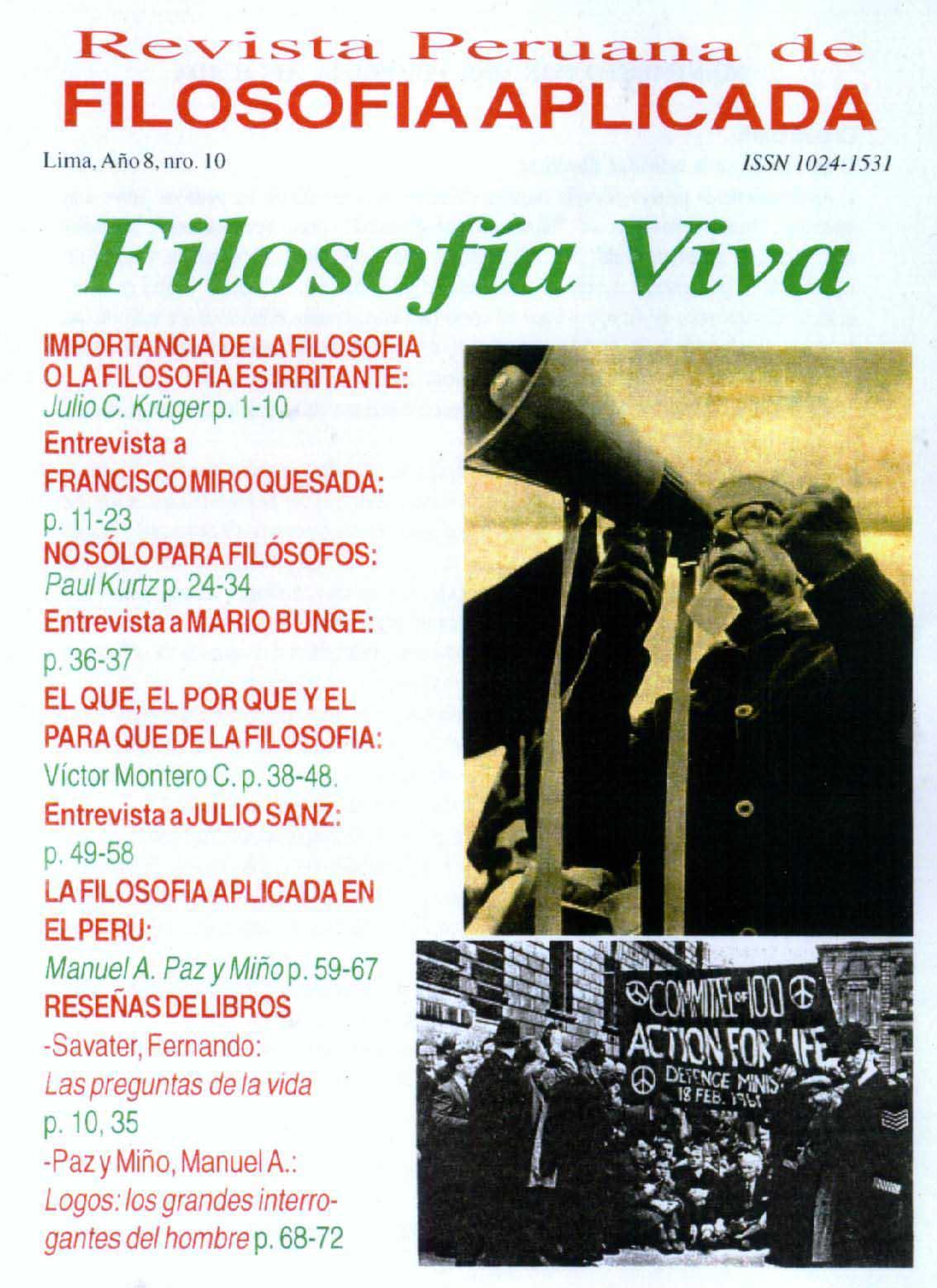
PERUVIAN JOURNAL OF APPLIED PHILOSOPHY # 10: PHILOSOPHY ALIVE (THE PRESENT MISSION OF PHILOSOPHERS)


Abstracts

IMPORTANCE OF PHILOSOPHY OR PHILOSOPHY IS IRRITATING: Dr. Julio César Krüger, Pos-Graduate School, University of San Marcos.
Philosophy is irritanting -or can be-, because it questions whatevvver one feels sure, then it produces confussion, contradicctions, conscience and thinkings (In order to prove this author departs from the Socratic method of questions and answers). Some times thinking is a disgust. Great philosophers teach to think says Heidegger. Of course philosophers like Heraclitus can be dark and that also is irritatingo. Or also they can provoke rage -like Diogenes the cynical to his heares and some times boredom and happiness as author wished with this paper.

FRANCISCO MIRO QUESADA CANTUARIAS: A LATIN-AMERICAN PHILOSOPHER (Interview)

PHILOSOPHERS ATTACK AGAIN!: Dr. Paul Kurtz, Profesor Emeritus, State University of New York.
Author critics the Anglo-American philosophy because it has troubles with linguistics. Philosophy has lost much of its intellectual interest and social significance in order to think in formalizations without contents. Much of the best thinkers were not academicians. And of course many were. But there are ones who are more creative abandoning the educative bureaucracy. Union of Philosophy with Theology, politics and educative institutions meant its death. Also philosophy is now like any profession and then it is very specialized and narrow, and so it is far away of the philosophical classic questions. Those ones are in the hands of other professionals. In general the influence of intellectual people is minimum in comparison to the mass'. However there is a need of philosophical reflection in these times of technological advance and social change.

MARIO BUNGE: A SELF-EDUCATED PHILOSOPHER (Interview)

TOWARDS AN APPLIED PHILOSOPHY: Lic. M. A. Paz y Miño, Peruvian Journal of Applied Philosophy.
It is about an applied philosophy for professional philosophers concerning present contemporary social topics but with the classical remarks (to be wondered, to question, to answer, etc.). Since that point of view it is mentioned the branches of an applied philosophy with their topics. Also the possibility of spreading philosophy through the media and high technology.

JULIO SANZ: A PERUVIAN PHILOSOPHER (Interview)

WHAT PHILOSOPHY FOR? (AN APOLOGY OF THE STOIC LIFE): Victor Montero, Pontifical Catholic University of Peru.
This paper is an anthropological meditation whose starting point is author's personal experience who, assuming a humanist and stoical position, tries to demonstrate that it is possible to reach a life philosophy (applied to daily and factual life) and this one may offer a total meaning to human existence. Thus, following classical humanist tradition, the author states that philosophy primarily concerns "problems of man as man".

REVIEWS AND NOTES

Back to the PERUVIAN JOURNAL OF APPLIED PHILOSOPHY's main page

To RPFA # 11

To RPFA # 9

PERUVIAN JOURNAL OF APPLIED PHILOSOPHY # 9: POLITICAL PHILOSOPHY


Abstracts

DEMOCRACY AND AUTHORITARISM
Dr. Juan ABUGATTÁS ABUGATTÁS Ph.D. in Philosophy, Professor, Universidad de Lima and Univ. de San Marcos
Notion and appraisal of democracy has been different in one time to another. For Aristotle the worst type of government was democracy, for Thomas Aquina monarchy was the better one. Only in Modern times some conditiones appeared in order to accept possitively democracy under the social contract, the natural laws and for mainly practical reasons (Locke). Montesquieu proposed a division of power. Rousseau introduced the radical notion of direct democracy. De Tocqueville thought in a democratic tirany of mayorities because of the conflict between equality and freedom. Finally in 19th century the right to vote appears in USA but only some human beings are considered voting citizens.

CONCEPTUAL DIALECTICS OF POLITICS
Dr. Antonio BELAÚNDE MOREYRA, Lawyer and former Ambassador, member of the Peruvian Society of Philosophy
Political sciences study policy, but what is policy? Against to the thesis that political sciences are the State theory is the one that says it is Power theory. Both of them are insatisfactory because not all in State life has a political feature and power has a wide and generic concept. A synthesis proposed to understand policy as a theory of the national community as global category that includes the public thing and the private one. Finally, the base of State is the national community.

DEMOCRATIC ETHICS
Dr. Paul KURTZ, Profesor emérito of Philosophy, State University of New York
Almost every political movement call itself champion of democracy because of its positive connotations, but in reality it has many enemies from left and right. We can speak in several senses of democracy but it is essential its ethical dimension in relation to equality and freedom. People should believe in a just and human democracy in order it works. Also an universal education, tolerance, civil disobedience, the rule of law, competence and participation. The democratic ideal is used as a comparative and descriptive model. In order to realize ethics in social reality democracy should work in political institutions and in a society open and without discrimination of all type.

LAW AS BASIS OF ADAM SMITH’S ECONOMY
Mr. Federico SALAZAR BUSTAMANTE, Journalist and host of the Peruvian TV news program First Edition. He studied Philosophy in Universidad de San Marcos
For Hobbes men who should subordinate to civil power (colectivism) but for Smith civil power must not subject human potential. The economic delay is caused by natural impediment and civil government’s views. When the state justice is not based in natural justice it creates a contrary effect, monopolies and state regulation violate individuals’ rights. Prosperity rise of a combination of legislation with moral as a result of the civil society’s evolution. In short, law is the basis of political economy. For Smith nations that prosper are those respectful of both natural freedom and justice of individuals. Social systems should not rise from imagination (of projectists, now they would be call utopic social engineers) but experience. Jurisprudence must protect individuals rights to be free and develop their talents.

RESPONSES TO:
-Zenón De Paz ‘s review of: Octavio OBANDO MORÁN’s The Peruvian Philosophical Making (published with Ediciones Espigón)
-Gustavo Flores’ review of: David SOBREVILLA’s Peruvian Contemporary Philosophy

REVIEWS OF:
-ARETE. Journal of Philosophy of the Pontifical Catholic University of Peru (PUCP) by Víctor MONTERO CAM, student of Philosophy, PUCP
-Gustavo FLORES QUELOPANA’s The Civilized Barbarism by Lic. Abraham PAZ Y MIÑO, AERPFA
-Augusto RUIZ ZEBALLOS’ Looking for a Political Center (Winner of the Peruvian National Essay Contest 1997, Univ. Nacional Federico Villarreal) by Lic. Carlos FLORES SORIA, Professor of History, UNFV

Back to the PERUVIAN JOURNAL OF APPLIED PHILOSOPHY's main page

To issue # 10

THE PERUVIAN JOURNAL OF APPLIED PHILOSOPHY # 8: ETHICS & MORAL


August 1997 (Abstracts)

ETHICAL THEORY & PRACTICE Prof. Brenda Almond (President, Society for Applied Philosophy, and Professor of Moral & Social Philosophy,University of Hull, England)
Author makes an introduction to the ethical theory and practice, both of them have appeared simultaneosly with philosophy. In the present practical or applied ethics -also applied philosophy- propose problems and answers derivative of science and technology. But such responses can both retrogress or better the social progress. For those reasons the role of philosophers can be very important if they have voice and participation in the public debates.

IT IS NEEDED A GOD IN ORDER TO BE A MORAL PERSON? Héctor Avalos (PhD, Professor of Religious Studies, Iowa State University)
This paper examines the idea that there exists an absolute morality that derives from a supernatural being. A comparison of different religions shows that a belief in a god does not guarantee the existence of absolute laws. Even within a single religion, such as Christianity, one can show that there are no absolute laws. Moreover, one can show that all moral laws are ultimately determined by human beings even when they profess to believe in a god.

MAN & ENVIRONMENT Leopoldo Chiappo (Emeritus Professor, Universidad Peruana Cayetano Heredia)
This author says that modern man has a technic-industrial-pragmatical-utilitarist conception of world -because of his culture- with three basic principles in relation to nature: 1. Mastery over it; 2. Consider it a thing and control it; and 3. It is something different to man. Then it characterizes a new ecological ethics: 1. Man is part of nature; 2. Nature is life; and 3. We must to reconcile with it.

WHAT IS EUPRAXOPHY? Dr. Paul Kurtz (Emeritus Professor, State University of New York, Council for Secular Humanis, Chairman)
A difference between religion and secular humanism is made. The former gives us a supernatural point of view of reality and the latter a natural one. Then it is proposed the term Eupraxophy -from the Greek roots: eu (good), praxis (practice) and sophia (wisdom)- in order to define secular humanism: a non neutral and not merely theoretic philosophy, by the contrary, a one commited itself to reason and ethics in order to get a better life here and now.

SENECA & STOICISM Luis León Herrera (Emeritus Professor, Universidad Cayetano Heredia)
It is about the ancient pedagogue and philosopher Seneca and his school of thinking: Stoicism. The stoic ideal made to whom practices it brave, strong and ele-gant during adversities, affronts and vicissitudes of life (illness, death, treason, poverty, etc.)

THE ANDEAN VIEW’S MORAL NORMS Dr. Mario Mejía Wamán (Professor, Faculty of Modern Languages, Univ. Ricardo Palma)
It is about The Inka’s morality: do not be a killer, do not be a adulterer. Preceding cultures to the Slavery’ mode of production have had moral norms similar to the Andean ones (e.g. the Mosaic Ten Commandments). Also with the Conquest, the Spanish bring here the Christian morality. Finally a brief paralel of the latter with the native morality is made.


To the next issue # 9 abstracts

To the previous issue # 7 abstracts

PERUVIAN JOURNAL OF APPLIED PHILOSOPHY # 7: THE UNIVERSITY MISSION

Dec. 1996 - Jan. 1997 

ABSTRACTS

THE UNIVERSITY MISSION: An interview to Dr. Benjamín Boccio La Paz, Rector, Universidad Inca Garcilaso de la Vega

THE HISTORICAL CONTROVERSY BETWEEN SCIENCES AND HUMANITIES: Bach. Ladislao Cuéllar, Departamento de Filosofía, Universidad Nacional Mayor de San Marcos
This paper is about the sciences-humanities controversy from a historical perspective. It begins in the decayed Hellenic culture -the fundamental basis of the Western Civilization- with the satirical work The Clouds by Aristophanes (4th Century b.c.e.), where he jokes of the Ionic philosophers' cosmological speculations, a fact that proves that the controversy of this paper is very closely related to the process of appeareance and development of science.

HUMAN AND SOCIAL SCIENCES: CRISIS OF PARADIGMS OR MULTIPARADIGMATICAL DISCIPLINES? Epistemological and ethical meditations: Pedro S. Gibaja Vargas-Prada, Ph.D., Faculty of Social Sciences, Universidad Católica del Perú
Author tries to present a conception of University and its Social Extension and services according to the present Peruvian Law. Also the author describes the works of San Marcos University Social Extension and services.

PERUVIAN UNIVERSITY: CHAINED PROMETHEUS?: Dr. Juan Rivera Palomino, Escuela de Posgrado, Universidad Nacional Mayor de San Marcos
Author tryes to understand the current situation of the Peruvian University as a pt of Philosophy, Universidad Nacional Mayor de San Marcos The author tries to present a conception of University and its Social Extension and services according to the present Peruvian Law. Also the author describes the works of San Marcos University Social Extension and services.

PERUVIAN UNIVERSIDAD: CHAINED PROMETHEUS?: Dr. Juan Rivera Palomino, Escuela de Posgrado, Universidad Nacional Mayor de San Marcos
Author tryes to understand the current situation of the Peruvian University as a product of the relations among that one and the State and the System of Production.

LATIN AMERICAN UNIVERSITY TOWARDS XXI CENTURY: Dr. Manuel Góngora, Departamento de Filosofía, Universidad Nacional Mayor de San Marcos
In the end of XX Century there is a new global order ruled by the owners of the industrial and finantial capital. They sell their science and technology to the underdeveloped countries but in what conditions? Who are the receptioners of those? Some people from the University but it is in a great crisis. We offer some alternatives of solution.

NEW UNIVERSITY AND SOCIETY, SOCIOLOGICAL MEDITATIONS: Dr. Roger Iziga, Univ. San Martín de Porras
History of University both in developed and developing countries is very distinct. In the 21th century we will be wittness of new changes because of the acumulation of the past troubles that in the last 500 years only produced colonialism and neocolonialism and great cultural, social, economic and political unequilities. Latin America goes to a new age where it will reach its development and real and independence but in this present step of undevelopment and dependence the University has a very important role as an agent of social change.

Back to the PERUVIAN JOURNAL OF APPLIED PHILOSOPHY's main page

To the next issue # 8 abstracts

To the previous # 6 abstracts

PERUVIAN JOURNAL OF APPLIED PHILOSOPHY # 6: BIOETHICS


May 1996 

ABSTRACTS

LLANOS ZULOAGA, Roberto (Peruvian Associacion of Bioethics): HONORIO DELGADO AND BIOETHICS IN PERU.
In Peru bioethics has not yet acquired its own identity. There is a Committee of Ethics in both the Peruvian Medical College and the National Comission against AIDS. Euthanasia is illegal. Transplantations of organs has not few obstacles. Many handicapped children are discriminated because of the possibility of contagion. State hospitals are obligated to accept patients with AIDS but not ever it is the case.

SANZ ELGUERA, Julio (Univ. San Marcos): BIOETHICS AND GENETICS.
Discovery of gens of homosexuality might give us the idea that other kind of behaviour, like altruism and the incest taboo be determinated as well. A first result in ethics would be to separate such kind of behaviour from morals because, according to Kant, duty implies power. However an examination of genetic conditions shows different results. For instance, only exceptionally the fenotype is determinated unilaterallyby gens. Environmental variations always play and important role, so one might presu-possed that in the determination of behaviour a more complex environment like the social one could be even more important. That is the trouble of the determination of conduct by environment.

PAZ Y MINO CONDE, M.A.(Univ. San Marcos): BEYOND GOOD AND EVIL: Cloning, cyborgs, crionics and ... (Recreating life).
In a general way it deals with some advances in biotechnology and their present and future influence in society's laws and moral.

CASAS N. Raymundo (Univ. San Marcos): THE PROBLEM OF ABORTION.
Author considers that society does not realize of the real problem of abortion. In order to defend that position he uses a jerarchy of moral duties and that he will apply to solve concrete problems on abortion. His argumentation grounds on the retoric principle of absurd-reduction.

MENDIVIL Z., Rolando (Univ. San Marcos): ETHICS IN TRANSPLANTATION OF ORGANS, About the donor.
Incessant evolution of the biological sciences has originated unusual situations where persons situate in a grand variety of occupations must get decisions that have great relation with the morality.The theme of the transplantation of organs it is not out of the moral criticism and we shall expose it particularly in relation to donor.

POLO SANTILLAN, Miguel A. (Univ. San Marcos): ETHICAL EDUCATION OF THE HEALTH PROFESIONALS.
It is a reflexion on the moral education of the Medical Sciences students analizing its different components: development of the course, participation of the teachers and students, etc. It is sugested to prepare to the future Health professionals not only in rules and beginnings but awaking a reflexive and attent mentality that have in account a global vision and a concret action towards to the problems of the professional career.

SALINAS M., Oscar (Univ. San Marcos): CONCEPTIONS OF HUMAN BEING & ITS INFLUENCE IN THE HEALTH POLITICS.
This paper will try to prove the existent relations between a determinated notion of human individual and the main remarks of a determinated health politics. Beginning of four notions of man -Christian, biological, structralist, funcionalist and Marxist- we can get the socio-political sense of them in the context of the health politics.
Back to the PERUVIAN JOURNAL OF APPLIED PHILOSOPHY's main page

To the next issue # 7 abstracts

To the previous issue # 5 abstracts